
Nothing Works the First Time With AI Agents
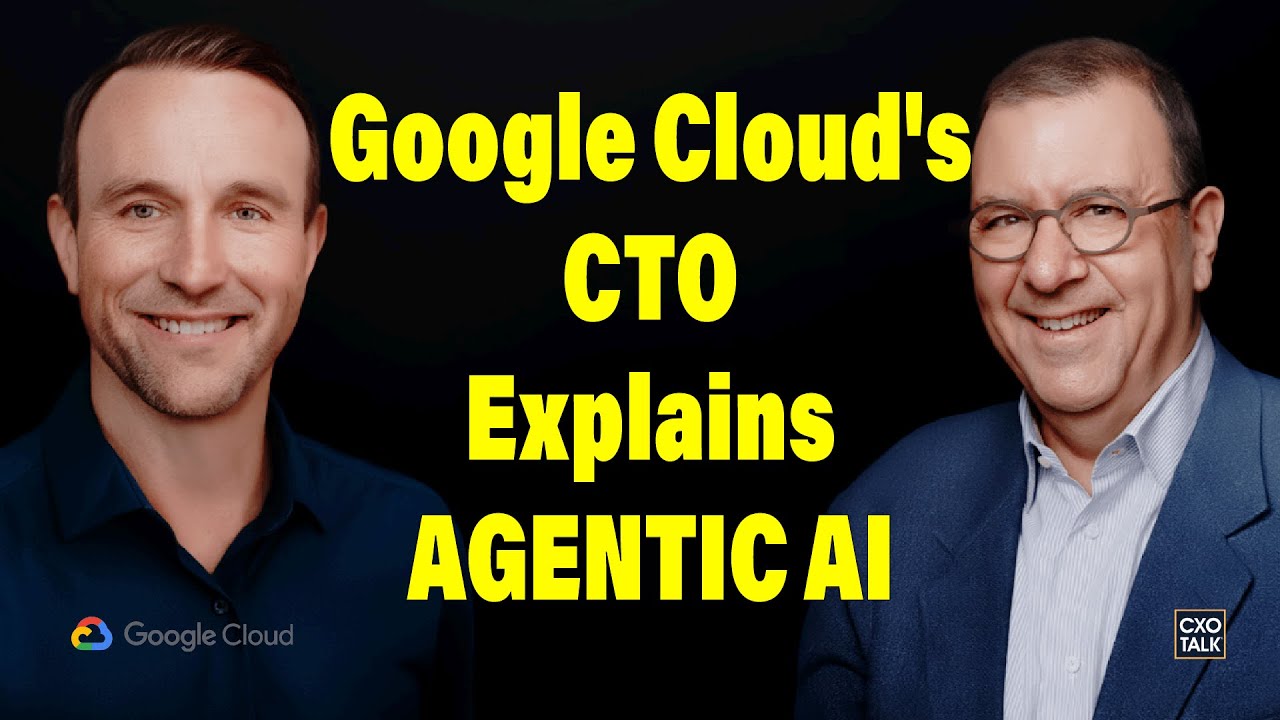
Enterprises are buying AI agents faster than they can operate them. The demo lands, the pilot behaves, and then the thing meets the real business and stalls. Will Grannis is Chief Technology Officer of Google Cloud, and he joined me the day after Gemini Enterprise launched, with 60,000 users at Highmark Health already getting their internal answers through agents.
Here is how I opened the show.
Google is betting billions on AI agents and multimodal models. But what’s really behind the strategy? Today, on CXOTalk number 897, Will Grannis, Chief Technology Officer of Google Cloud, takes us inside what you need to know now. I’m your host, Michael Krigsman. Let’s get into it.
Michael Krigsman, CXOTalk episode 897
What came back was an operations story rather than a product story. The most useful line of the hour is one that no vendor keynote will ever put on a slide.
Agents are a third wave, and they act
I asked Grannis what is happening in the agent world before we talked about what Google is building.
So agents are kind of like, almost like this third wave of automation and intelligence in that they can take intent, and they can take it in a variety of ways. It can be typed, it can be spoken, and it can execute tasks on your behalf.
Will Grannis, Chief Technology Officer, Google Cloud
The load-bearing words sit at the end. A chatbot produces text and a person decides what to do with it. An agent decides and then does it. That one change moves your exposure from the quality of an answer to the consequence of an action.
Nothing works the first time
Grannis spent a long stretch on evals, the practice of scoring an agent continuously rather than testing it once before launch. I put it to him plainly.
It’s really interesting the way you describe these eval points, putting them through the entire process frequently enough. Would it be correct to say that you are making many, many, many, many small course corrections? Is that an accurate way to say it?
Michael Krigsman, CXOTalk episode 897
So to your point, Michael, it’s an iterative cycle. Nothing works the first time. Nothing works the first time.
Will Grannis, Chief Technology Officer, Google Cloud
He said it twice, which is how people talk when they have watched it happen. The budget consequence is immediate. A program funded as a build with a launch date is mispriced, because the launch is where the work starts. Grannis put the same idea a second way: “Training AI isn’t the end, it’s the beginning.” If your business case has no line for continuous evaluation after go-live, you have not funded the project. You have funded the demo.
Regulated industries are ahead, and that tells you what the work is
Whereas we tend to think of technology as, you know, coming to regulated industries second or a little bit later, in the world of agents, they’re seeing time to value a little faster because they already have all of those key business processes and data documented that could then feed the agent execution and the agent rules through a workflow.
Will Grannis, Chief Technology Officer, Google Cloud
Read that twice, because it inverts the usual assumption. Banks and hospitals are not ahead because they have better models. Everybody has the same models. They are ahead because a regulator forced them, years ago, to write down how decisions get made. An agent can only execute rules that exist in writing. Where the rule lives in a senior manager’s head, the agent has nothing to execute.
Grannis was direct about where advantage now sits: “And that’s where differentiation and that’s where competitive advantage lies. It doesn’t lie in accessing the same model everybody has access to.” Your documented process and your own data are the differentiator. That is unglamorous work, and it is the work.
The software will not guess what you meant
I described the fantasy that a lot of executives are quietly holding.
You’re the CTO of Google Cloud, and we want the AI to intuitively know and understand our implicit rules of engagement and our implicit culture, so we can just let the software do its thing and help us.
Michael Krigsman, CXOTalk episode 897
You know, it’s important that, to understand that if you ask software to do something, it will do it. If you don’t ask software to do something, it won’t do it.
Will Grannis, Chief Technology Officer, Google Cloud
Implicit culture is not an input. The unwritten norms, the exceptions everyone knows about, the customer you never escalate: none of it reaches the agent unless somebody types it. Grannis named the consequence directly. “Lack of data, lack of context to the agents and the models is the number one trap door.” Not model quality. Context.
An audience question landed on the problem nobody has solved
The sharpest question of the hour was not mine. Stephanie Tsatsos, an account executive at Workday, asked on LinkedIn whether agents are role-based or skills-based, which is to say whether one agent equals one job to be done or one agent equals one task. Grannis said the field sits at two ends of a spectrum today, with narrow single-task agents that a person builds for themselves at one end and larger multi-agent arrangements at the other. The middle is unsettled.
Then he said the part a keynote leaves out.
Debugging multi-agent workflows right now is very, very complicated.
Will Grannis, Chief Technology Officer, Google Cloud
That is the CTO of Google Cloud describing the category his own company sells into. If you are drawing an architecture where ten agents call each other across three systems, price the debugging before you set the launch date.
I have been writing this story for twenty years
I spent two decades writing about IT project failure for ZDNet and founded a consultancy, Asuret, to diagnose it. ERP, CRM, data warehouses, and now agents. The technology changes and the failure does not. Organizations buy a capability and skip the part where they have to describe their own work precisely enough for a machine to run it. The pilot succeeds because a strong team hand-carried it. Production fails because nobody wrote it down.
And I will also say that in the history of technology, we always underestimate how profound the changes are gonna be, and we overestimate how fast they’re going to happen.
Will Grannis, Chief Technology Officer, Google Cloud
That sentence is the whole discipline. On the path there, Grannis needed four words: “There are no shortcuts.”
What to do with this on Monday
Start with a process that is already documented, because that is the only place an agent has something to stand on. Fund the evaluation loop as a permanent operating cost rather than a project phase, and expect many small corrections rather than one clean cutover. Before you approve a multi-agent design, ask your team how they will debug it when a decision comes out wrong three hops in, and treat a vague answer as the risk it is. On governance, Grannis was compact: “Measure, measure, measure, and be very transparent.”
And do not wait for the strategy deck to be finished. At the end of the show I amplified his advice, and I will repeat it here: “I just have to amplify, Will, a comment that you made earlier, which is just get started. If you’re a small business, the more you can gain familiarity with the kind of services, for example, that Will was just describing, the better off you’re gonna be. And you’ll, then you’ll learn and you’ll know how to, how to take those tools and apply them to your specific business.”
Watch the full conversation: Inside AI Strategy with Google Cloud’s CTO, CXOTalk episode 897, and read the complete transcript. Will Grannis is Chief Technology Officer of Google Cloud.

Michael Krigsman
Michael Krigsman is an industry analyst and the founder and host of CXOTalk, where he has interviewed close to 900 C-level leaders since 2013. He spent two decades writing about IT project failure for ZDNet and founded Asuret, a consultancy built to diagnose why enterprise projects go wrong. He is based in Boston. More about Michael or get in touch.