
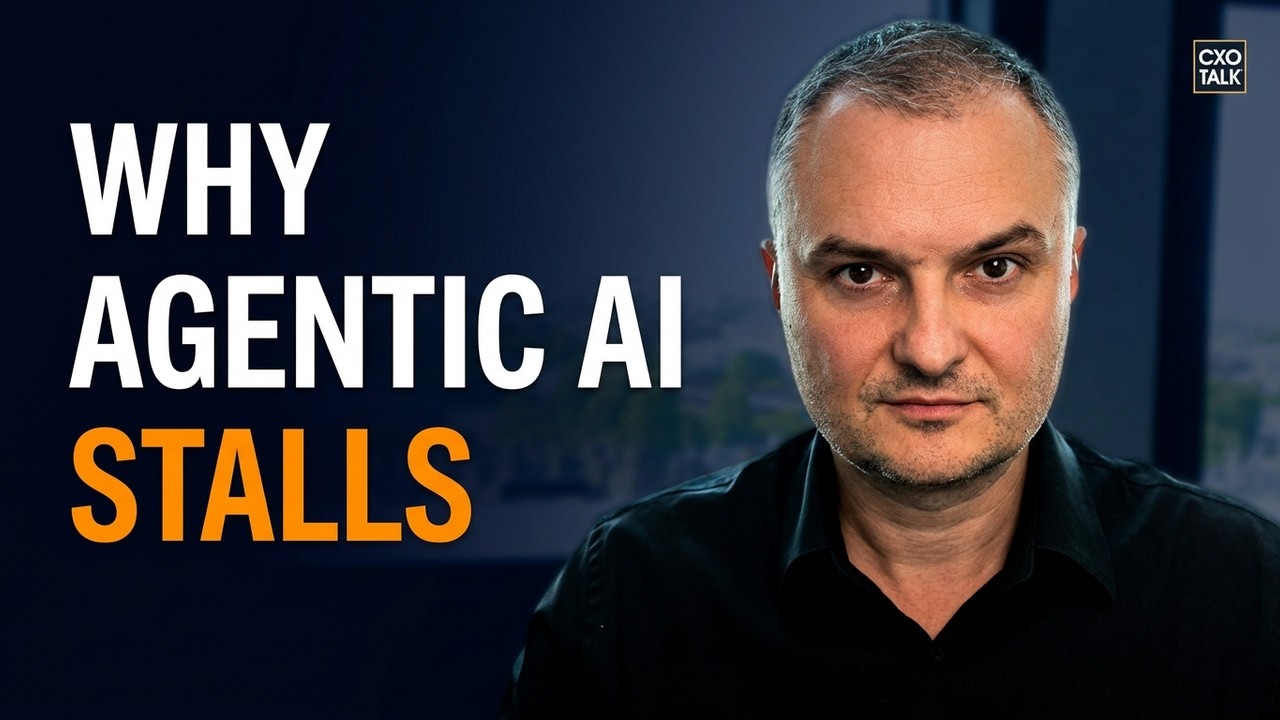
Why Most AI Pilots Never Reach Production
Fewer than 100 companies have captured most of the value that artificial intelligence has created so far. Not most of the Fortune 500. Fewer than one hundred companies, anywhere.
That number comes from QuantumBlack, McKinsey’s AI practice, which has looked at thousands of transformations across the globe. I put it to Alexander Sukharevsky, who leads that practice, on episode 922 of CXOTalk. Here is how I opened the show:
Less than 100 companies so far have captured more than 2/3 of the value. They did it in two or less domains with one to three return ratio. Companies spend billions chasing AI. Few find value.
Michael Krigsman, CXOTalk episode 922
One to three. Every dollar in, roughly three dollars back. The winners are not doing more AI than everyone else. They are doing something structurally different, and Sukharevsky argues that the difference is knowable, repeatable, and boring.
The recipe is invariant
I asked him what actually has to be in place before AI produces value. His answer was not a list of technologies.
It’s really about an holistic approach, focusing on a few domains and trying to reinvent them, finding the right data to power this reinvention, aligning your architecture, finding the right talent, and upskilling the rest of the organization, changing your operating model, as well as focusing on economics.
Alexander Sukharevsky, Global Leader, QuantumBlack, AI by McKinsey
Then came the sentence that reframes the whole problem:
So first of all, it’s invariant. There is only one way to go in terms of different elements of the journey.
Alexander Sukharevsky
Invariant means you do not get to pick your favorites. Data, architecture, talent, operating model, economics. All of them, or the value does not show up. That is why so many programs produce impressive pilots and no P and L movement. They completed four of the six things and assumed the rest would follow.
I have been writing about this failure shape since my ZDNet years, and it has not changed. The technology is rarely the thing that breaks. The organization around it is.
Two domains, not twenty
The second finding is about focus, and it is the opposite of what most enterprise AI portfolios look like.
The companies that transformed themselves actually focused on 2 or less domains. So it’s really about focus. But then the important part is not just infusing technology within the current business model, but thinking about complete reinvention.
Alexander Sukharevsky
Most companies I talk to are running dozens of AI initiatives across every function, each one sponsored by a different executive, each one measured on its own terms. That portfolio looks like progress on a slide. It is the statistical reason nothing lands. Spreading effort across twenty domains guarantees you will not get all six elements right in any of them.
The CEO is the chief transformation officer
This is the part that will be unpopular in IT leadership circles, and Sukharevsky did not soften it.
I truly believe that the transformation should be driven by the CEO and the board. Because if it is driven just by the CTO or chief digital officer, what we see in most of the cases, it ends up with a lot of amazing pilots that frankly show impact. It also ends up with a lot of interesting technology solutions and very advanced platforms, but it does not bring to the full change of the organization and the rewiring the organization. And therefore, the person who should be chief transformation officer is the CEO of the organization.
Alexander Sukharevsky
He was careful to add that the CIO and CTO are not spectators. Their job is to guide the CEO, because the CEO is the only person in the building who owns the strategy, the investor expectations, and the direction of travel at the same time. But when the transformation reports to technology, technology is what you get. You do not get a rewired company.
Human in the loop, with teeth
The live audience pushed the conversation somewhere better than my questions did. Monique Zytnik wrote in on LinkedIn with one line that landed harder than anything else in the hour:
Agents don’t have consequences if they don’t perform.
Monique Zytnik, audience question, CXOTalk 922
Sukharevsky’s answer was that the accountability never moves. You redesign the process, you monitor the execution, and you make sure the team is accountable for the outcome whether or not agents did the work. Which led me to say what I think is the practical takeaway of the whole episode:
So human in the loop then is not simply overseeing the machine and rubber stamping, but actually performing an ongoing critical evaluation of what the agent is doing based on your expertise and, very importantly, your judgment.
Michael Krigsman
And then, because the phrase has been drained of meaning by overuse:
It’s not the agent that is accountable, but it’s the human in the loop, because so often we hear human in the loop as this kind of jargony buzzword, but you’re putting the accountability on that human in the loop so there’s actually some teeth there.
Michael Krigsman
If your governance document says human in the loop and nobody’s name is attached to the outcome, you do not have human in the loop. You have a diagram.
What to do with this on Monday
Three things, drawn directly from what the data says about the companies that made it work.
Cut your AI portfolio down to the one or two domains that actually create most of your value, and reinvent those rather than decorating them. Move sponsorship of the program from the technology organization to the CEO and the board, and let the CIO and CTO advise rather than own. Then put a human name against every outcome an agent touches, so that when the agent is wrong, a person is answerable.
None of this is a technology decision. That is exactly the point, and it is why fewer than a hundred companies have managed it.
Watch the full conversation: McKinsey on Agentic AI: How to Create Business Value, CXOTalk episode 922, with the complete transcript. Alexander Sukharevsky is the Global Leader of QuantumBlack, AI by McKinsey.

Michael Krigsman
Michael Krigsman is an industry analyst and the founder and host of CXOTalk, where he has interviewed close to 900 C-level leaders since 2013. He spent two decades writing about IT project failure for ZDNet and founded Asuret, a consultancy built to diagnose why enterprise projects go wrong. He is based in Boston. More about Michael or get in touch.